Harry Herbert Biography: Life, Family, Racing Career, Highclere and Net Worth

Harry Herbert was born into one of Britain’s most recognisable racing families, but his eventual career was anything but a simple inheritance. The son of Henry Herbert, 7th Earl of Carnarvon—better known in racing circles as Lord “Porchester” and remembered as Queen Elizabeth II’s longtime racing manager—Harry grew up surrounded by horses, breeding and the traditions of the British aristocracy. Yet, remarkably, racing did not immediately capture his imagination. In later interviews, Herbert has openly recalled that he initially disliked the sport, making his eventual transformation into one of Britain’s best-known racehorse syndicate entrepreneurs all the more intriguing.
His career changed dramatically after he travelled to Kentucky and entered the bloodstock business. There he developed a deeper understanding of thoroughbred pedigrees, horse selection and the commercial side of racing. When he returned to Britain, he used that experience to create a new approach to ownership. In 1992, he founded Highclere Thoroughbred Racing, building a business around shared ownership that allowed groups of people to experience elite horse racing without having to bear the entire cost of owning a racehorse themselves.
More than three decades later, Harry Herbert remains a prominent figure in British horse racing. Highclere has produced major winners, competed at the highest level and helped make racehorse syndication a lifestyle experience as much as a financial or sporting proposition. His personal life has also attracted attention, particularly since his marriage to Irish chef and television personality Clodagh McKenna. Together, they have built a distinctive countryside life at Broadspear on the Highclere estate, combining food, farming, animals, hospitality and the traditions of rural Hampshire.
Harry Herbert Facts at a Glance
| Fact | Details |
|---|---|
| Full name | The Hon. Harry Herbert |
| Date of birth | March 2, 1959 |
| Age | 67 in 2026 |
| Birthplace | Highclere Castle, Hampshire, England |
| Profession | Thoroughbred racing entrepreneur, bloodstock specialist and racehorse syndicate executive |
| Best known for | Founding Highclere Thoroughbred Racing |
| Father | Henry Herbert, 7th Earl of Carnarvon |
| Mother | Jeanie Margaret Wallop, Countess of Carnarvon |
| Brother | George Herbert, 8th Earl of Carnarvon |
| Sister | Lady Carolyn Warren |
| Education | Eton College |
| Wife | Clodagh McKenna |
| Children | Chloe, Francesca and William |
| Main company | Highclere Thoroughbred Racing |
| Industry | Horse racing, bloodstock and racehorse ownership |
| Notable success | Motivator’s 2005 Epsom Derby victory |
| Current focus | Highclere syndicates, bloodstock selection and racehorse ownership |
| Estimated net worth | No reliably verified public figure |
| A personal Instagram presence is associated with Harry Herbert, although public activity is relatively limited | |
| Professional social media | Highclere Racing maintains public social channels |
Who Is Harry Herbert?
Harry Herbert is a British entrepreneur and racing executive who has spent much of his professional life at the intersection of thoroughbred breeding, horse ownership and syndication. He is best known as the founder of Highclere Thoroughbred Racing, a company established in 1992 with the aim of creating an ownership experience that could bring more people into the upper levels of British horse racing. His work has helped turn shared racehorse ownership into a sophisticated business and social experience.
What distinguishes Herbert from many traditional figures in racing is the combination of heritage and innovation behind his career. His family already possessed an extraordinary connection to the sport, but Herbert did not simply step into his father’s position. Instead, his professional development took him away from England and into Kentucky’s bloodstock industry, where he learned about pedigree analysis, horse selection and racing from a different perspective. That experience later influenced the way he built Highclere.
Herbert has also become known for the personality he brings to racing. Profiles of him often describe a charismatic, enthusiastic and highly sociable figure who views ownership as an emotional experience rather than merely an investment. His philosophy is particularly important to Highclere because the company’s appeal lies not only in the possibility of owning part of a successful horse but also in attending races, meeting trainers, watching young horses develop and sharing victories with fellow owners.
Early Life at Highclere Castle
Harry Herbert was born at Highclere Castle in Hampshire on March 2, 1959. The estate has an extraordinary place in British popular culture today because it serves as the setting for Downton Abbey, but long before the television series made the castle famous worldwide, Highclere was the Herbert family’s ancestral home. Harry’s childhood therefore unfolded in an environment of country estates, horses, farming, sporting traditions and aristocratic social life.
His father, Henry Herbert, 7th Earl of Carnarvon, was one of the most important figures in post-war British racing. Known earlier as Lord Porchester, he became Queen Elizabeth II’s racing manager in 1969 and held the position until his death in 2001. The relationship went beyond professional duties: the two shared a long friendship and a deep interest in horses, breeding, countryside life and wildlife.
That background meant racing was constantly present during Herbert’s childhood. Yet instead of automatically becoming fascinated by it, he initially found the constant discussion of horses and racing rather tiresome. Herbert has described himself as having little early interest in the sport, an admission that adds an unusual twist to his biography. His eventual passion for racing was therefore something he discovered rather than something he simply inherited.
Family Background and Influences
Harry’s family background placed him at the centre of an important network within British racing. His brother George Herbert later became the 8th Earl of Carnarvon and continues to be associated with Highclere Castle and the estate. His sister Carolyn married John Warren, an influential bloodstock adviser who became closely associated with the royal racing operation. This extended family connection gave Harry access to an extraordinary depth of knowledge about breeding and racehorse selection.
His father’s influence was especially significant, even though Harry did not initially follow him directly into the profession. Henry Herbert’s career demonstrated the importance of careful bloodstock selection and long-term breeding strategy. As Queen Elizabeth II’s racing manager, he was involved with horses, trainers and breeding decisions at the highest level of the sport, while also playing a wider role in British racing administration.
For Harry, growing up in such a family created both an advantage and a challenge. He had access to people and experiences that most aspiring racing entrepreneurs could never reach, but he also needed to establish an identity of his own. His eventual success with Highclere can therefore be seen partly as an attempt to take that inherited knowledge and transform it into a business model with a distinct modern purpose.
Education at Eton and an Uncertain Beginning
Herbert attended Eton College, one of Britain’s most famous independent schools. His education placed him in an environment that could have naturally led toward traditional aristocratic professions, finance or estate management. However, his early career did not follow a straight line, and he spent time exploring different possibilities before finding his real professional direction.
At one stage, Herbert worked in the City of London in stockbroking. He also had an interest in acting and reportedly considered the possibility of becoming a performer. These early ambitions are revealing because they show that the future head of Highclere was not simply following an obvious family blueprint. He was searching for an occupation that matched his personality and interests.
The decisive change came when he went to the United States. His time in Kentucky exposed him to a professional bloodstock environment where horse racing was treated as a serious commercial and analytical industry. Working there helped awaken the interest that had previously been dormant, giving Herbert a new appreciation for pedigrees, breeding decisions and the business mechanics behind successful racehorses.
The Kentucky Experience
Kentucky proved to be a crucial chapter in Herbert’s development. The region is one of the world’s major centres of thoroughbred breeding, and working there gave him an opportunity to learn away from the expectations associated with his family name. Instead of being known primarily as the son of Lord Porchester, he had to demonstrate that he could understand the bloodstock business himself.
He worked for Bloodstock Research under businessman Barry Weisbord. The company used computer-based pedigree research to examine thoroughbred bloodlines, giving Herbert exposure to a more analytical approach to horse breeding. This was especially significant at a time when data-driven approaches were far less commonplace than they are today.
The experience changed his attitude toward racing. Herbert began studying pedigrees intensely and developing an understanding of why particular stallions and mares were selected for breeding. He later described himself as a dormant gene that had finally been activated, a fitting description for someone whose childhood was immersed in racing but whose passion for the sport emerged only later in life.
Returning to Britain and Building a Career
After his American experience, Herbert returned to Britain with a much clearer professional direction. He became involved in bloodstock management and representation, building contacts across the racing and breeding industries. These years helped him develop the commercial knowledge and relationships that would later become essential to Highclere’s success.
Before launching Highclere, Herbert was involved with Kennet Valley Thoroughbreds alongside Nick Robinson. The venture experimented with the syndication model and showed how groups of owners could participate in high-level racing. Although the business faced difficulties during the economic pressures of the early 1990s, the experience gave Herbert an important lesson: there was a market for shared ownership if it was structured professionally and presented as an exciting experience.
Rather than abandoning the idea after those challenges, Herbert refined it. He recognised that the ownership experience itself could be the product. People did not necessarily need to own an entire racehorse to feel genuine excitement and connection to the animal. If they could own a share, meet the trainers, visit the yard and attend major races, the experience could become accessible to a much broader audience.
Founding Highclere Thoroughbred Racing
In 1992, Harry Herbert founded Highclere Thoroughbred Racing. The objective was to establish a professional racehorse ownership business built around carefully selected thoroughbreds and multiple owners. Over time, Highclere became one of Britain’s most prominent racehorse syndication operations, combining bloodstock expertise with an emphasis on hospitality and owner engagement.
The model was relatively simple in principle. Instead of asking one individual to pay the entire purchase price and ongoing training costs of a racehorse, Highclere could divide ownership among a group of people. This reduced the financial burden for each participant while creating a community of owners who could share the excitement of racing. Herbert’s approach helped make elite ownership feel less exclusive.
But the company was never simply about selling pieces of horses. Herbert developed a complete lifestyle around ownership. Highclere events have included yearling parades, stable visits, lunches, race days and opportunities to meet trainers and bloodstock professionals. The result is a model in which the social experience can be almost as important as the horse’s performance on the track.
Highclere’s Racing Success
The success of Highclere is ultimately measured by its horses. Since the company was established, its syndicates have achieved wins and major placings at some of the most important meetings in British racing. Highclere’s own profile states that its horses have won or been placed in eight British Classics, a remarkable record in a sport where even highly regarded bloodstock can fail to perform as expected.
One of the company’s standout horses was Motivator, who won the 2005 Epsom Derby for the Royal Ascot Racing Club. The victory became a defining moment in Herbert’s career because it demonstrated the extraordinary sporting possibilities of the shared-ownership model. The horse had been bought for 75,000 guineas and went on to become one of the most celebrated horses associated with the organisation.
Highclere has also enjoyed important commercial successes. Its 2026 syndicate material highlighted the sale of Believing for £3 million at Tattersalls and the earlier sale of Cachet for £2.2 million. Both horses had also generated more than £500,000 in prize money, illustrating how a successful racehorse can provide owners with both sporting memories and significant commercial value.
Harry Herbert’s Philosophy on Racehorse Ownership
One of Herbert’s most important contributions has been his insistence that people should approach racehorse ownership primarily for the experience. The sport involves substantial costs and considerable uncertainty, and even expensive horses can fail to win. Herbert has therefore emphasised enjoyment, relationships and memorable racing days rather than presenting ownership as a guaranteed financial investment.
This philosophy is visible in Highclere’s events. Owners can see young horses before they race, listen to explanations about conformation and movement, meet trainers and bloodstock specialists, and experience the anticipation that builds before a major race. Herbert has described this process with enormous enthusiasm because he understands that anticipation itself is part of the pleasure of ownership.
The model also reflects Herbert’s personality. He is known for being highly social and emotionally invested in racing. Rather than treating the horses as abstract assets, he presents them as living athletes whose development creates stories and friendships. That human element has been central to Highclere’s brand for more than 30 years.
Personal Life and Marriage to Clodagh McKenna
Harry Herbert’s personal life became more widely known after his relationship with Irish chef, author and television personality Clodagh McKenna. The pair met in 2017 through mutual friends at a Fortnum & Mason lunch in London. Their relationship developed relatively quickly, and they eventually built a shared life centred on the countryside and hospitality.
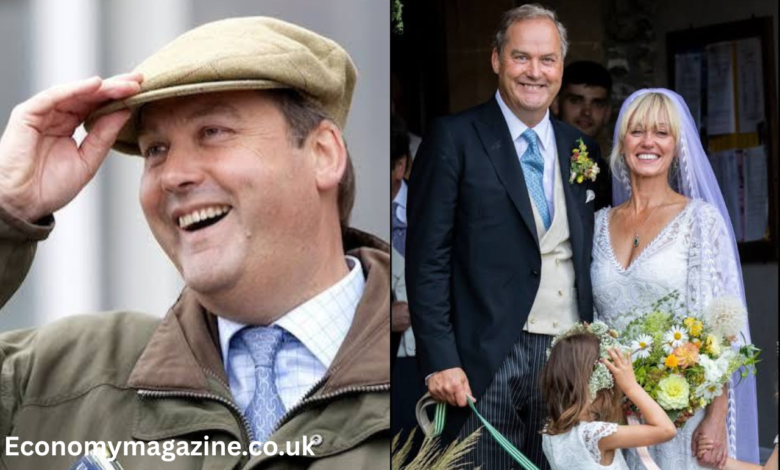
They married on August 14, 2021, at St Michael and All Angels Church on the Highclere estate. The location was particularly meaningful because Highclere is both Herbert’s family home and the estate internationally associated with Downton Abbey. Their wedding brought together members of both families and numerous friends from the worlds of food, entertainment, aristocracy and racing.
The couple live at Broadspear, a historic property within Highclere Park. Their lifestyle is strongly connected to food, animals, gardens and sustainable farming. A 2025 profile described their home as part of a substantial sustainable farm with animals, beehives and gardens, reflecting the couple’s shared interest in creating a productive countryside environment rather than simply maintaining a traditional country residence.
Family and Life at Broadspear
Herbert has three children from his previous marriage: Chloe, Francesca and William. They were among the family members present at his wedding to McKenna. His wider family continues to have a strong connection with Highclere, meaning that his personal life remains closely connected to the estate that has shaped so much of his identity.
Life at Broadspear appears to be considerably more hands-on than the image of a conventional aristocratic country estate might suggest. Herbert and McKenna have worked to develop the property and its surrounding land, with animals, gardens and food production becoming part of their everyday environment. McKenna has spoken about the effort involved in transforming the neglected area into the countryside home it is today.
Their shared interests also complement each other professionally. Herbert works in racing and bloodstock, while McKenna’s career centres on food, cooking, books and television. Their home therefore becomes a meeting point between two very different industries, with racing events and country hospitality frequently forming part of their lifestyle.
Harry Herbert’s Net Worth and Income
Determining Harry Herbert’s exact net worth is difficult because there is no authoritative public financial statement that reveals the full value of his personal assets, business interests, investments and property. Figures published by celebrity and financial websites should therefore be treated carefully rather than repeated as established fact. A responsible biography should distinguish between documented business activity and speculative estimates.
Herbert’s principal professional income has historically been associated with Highclere Thoroughbred Racing and related racing activities. His work encompasses racehorse syndication, bloodstock selection, management and ownership, while he has also held prominent positions connected with racing organisations. His long career and the scale of Highclere’s operations indicate substantial commercial success, but they do not provide enough information to calculate a precise personal fortune.
There is also an important distinction between the value of horses and the wealth of the person managing them. Highclere has reported major sales—including Believing for £3 million and Cachet for £2.2 million—but those figures represent transactions involving racehorses and their ownership structures rather than Harry Herbert’s personal earnings.
Social Media and Public Image
Unlike many modern public figures, Herbert has never built his reputation primarily through social media. His public profile has been driven much more by racing journalism, major events, Highclere’s ownership network and his appearances at leading British race meetings. His personal social-media activity is relatively understated compared with that of his wife, whose television career and lifestyle brand give her a much larger online presence.
Highclere’s own digital channels provide a much clearer window into Herbert’s professional world. The company’s online content regularly features new syndicates, yearlings, trainers, race days and owner experiences. Through these channels, Herbert and his team communicate the central idea behind Highclere: racing is about participation, anticipation and community as much as it is about results.
His public image is consequently built around expertise, enthusiasm and accessibility. He occupies a rare position in British racing: someone with aristocratic heritage who has nevertheless spent decades actively promoting a form of ownership designed to bring a wider range of people into the sport.
Harry Herbert and the Future of Highclere
Highclere continues to develop new syndicates and search for future racehorses. In its 2026 syndicate material, Herbert described the organisation’s new group of horses as particularly promising and highlighted a strong team of two-year-olds. He also noted that he would continue attending major yearling sales alongside his nephew Jake Warren in search of the next generation of Highclere prospects.
That next generation is important because Highclere’s model depends on continually identifying horses with the potential to compete at the highest levels. Herbert works with bloodstock experts, veterinarians, trainers and family members to assess horses before purchase. The selection process can involve examining large numbers of yearlings before narrowing the field to a small number of serious prospects.
The future challenge is therefore not simply finding winners. Racing is changing, ownership models are evolving and costs remain significant. Herbert’s continuing task is to make shared ownership attractive enough that new participants want to join while maintaining the standards of horse selection and professional management that built Highclere’s reputation in the first place.
Legacy and Influence on British Horse Racing
Harry Herbert’s greatest contribution may be the way he changed the perception of racehorse ownership. Traditionally, elite thoroughbred racing could appear to belong almost exclusively to extremely wealthy individuals, aristocratic families and major commercial operations. Highclere demonstrated that groups of ordinary enthusiasts could participate in the same world through carefully organised syndicates.
His achievement is especially notable because it combines two seemingly opposite qualities: respect for tradition and willingness to innovate. Herbert has remained deeply connected to the rituals of British racing—Royal Ascot, major race meetings, bloodstock sales and classic races—while simultaneously creating a business model that makes participation more accessible.
The result is a career that extends beyond individual winners. Highclere has created a community of owners who share the highs and lows of racing, from watching a young horse at a yearling parade to cheering it at a major meeting. In that sense, Herbert’s legacy is not measured only by trophies and sale prices but also by the number of people who have been introduced to the sport through his vision.
Conclusion
Harry Herbert’s biography is ultimately a story about discovering a passion rather than simply inheriting one. Born at Highclere Castle and raised in a family deeply connected with British racing, he might have seemed destined to enter the sport from the beginning. Instead, his early lack of interest led him down a less predictable path, eventually taking him to Kentucky, where bloodstock research and the international racing industry awakened the passion that would define his professional life.
The founding of Highclere Thoroughbred Racing in 1992 transformed that passion into a lasting business. Through shared ownership, Herbert created a way for people to experience the excitement of elite racing without needing to purchase and maintain an entire racehorse independently. Major successes such as Motivator’s Derby triumph, along with numerous other high-level performances and valuable bloodstock sales, established Highclere as a significant force in modern British racehorse ownership.
His personal life has added another fascinating chapter. His marriage to Clodagh McKenna and their life at Broadspear combine the worlds of racing, food, farming and countryside living. Yet perhaps the most enduring lesson from Herbert’s career is that background does not have to determine destiny. Heritage can open a door, but curiosity, persistence and the courage to develop a different idea are what create a lasting legacy.
As Harry Herbert continues searching for the next Highclere champion, his journey remains a reminder that success is not simply about where someone begins. It is about recognising an opportunity, developing genuine expertise and turning personal passion into something that can be shared with others. In an industry built on centuries of tradition, Herbert has created a modern legacy based on participation, community and the enduring thrill of seeing a horse race toward the finish line.